
 Online gambling, much like videogames, is one of those industries that just keeps growing bigger and better with every year. As technology improves and various companies and online casinos compete for their audience’s attention, we keep seeing new and better stuff trying to woo us every single month – and if predictions and announcements hold true, then that trend will be alive and well in 2018! Just check out this constantly updated list of new online casinos and check out all of the casinos that are set to officially launch within the current year! It’s pretty crazy to think of just how much stuff we’ve got to look forward to, including some really wild slots!
In the Playtech corner of the casino universe, I think it’s fair to say that we lost some and we won some. Late last year, all of the developer’s beloved Marvel slots suddenly went down (in a move that we absolutely should’ve anticipated, given the fact that Playtech’s contract expired back in 2013), which was a pretty bad blow. On the plus side, all of them are expected to return in 2018 as the “Age of Gods” series, which reskins them to make them about conveniently public domain Greek gods and not licensed Marvel superheroes. On the other hand, we’ve also got Playtech’s VERY licensed DC slots, some of which released last year to critical acclaim, while others, such as “Suicide Squad” and “Batman V Superman” expected to release sometime this year. The release of the “Suicide Squad” will also mark one of the very few times in which an Academy Award-winning motion picture was adapted into a slot machine.
On NetEnt’s side, they’ve already got a ton of slots announced through March of this year. Their collaboration with Universal to bring some classic monsters to life in slot form already gave us hits like “The Invisible Man”, and is bound to bring us an adaptation of “Phantom of the Opera” in just a few weeks! But the slot that I’m personally most excited for is set to release in March. Its original title was “Miami Pursuit”, but has since been changed to “Hotline”. It’s really not hard to figure out that the slot will be based on the videogame “Hotline Miami”, which offers a brutal, yet stylistically brilliant romp throughout 80s Miami. While I don’t expect this to be a straight adaptation of the game, I definitely expect this to be the most purple slot of 2018.
Alas, Microgaming comes dead-last on the hype-o-meter, since they’ve only announced one slot so far – “Lucky Little Gods”, which is set to come out in early February, and honestly, doesn’t look all that revolutionary. While their recently released “Highlander” slot makes an implicit promise of great things to come, I’m afraid that right now we just don’t know that much of Microgaming’s plans for the year. Still, I’m sure that by the time “Lucky Little Gods” releases we’ll have a more comprehensive idea of what to expect from the developer, since they tend to release their schedules a bit later than their competitors. Until then, we’re going to have to remain content with using our imaginations. Here’s hoping they’re able to live up to the hype! And if they don’t, well, there’s always NetEnt’s “Hotline” to keep us satisfied this year.
 This exciting video slot is based on
 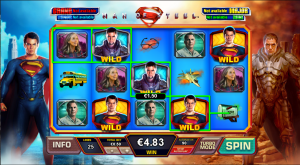 This Superman movie-themed jackpot slot is packed full of wild features. In the base game, Superman and General Zod are shifting wilds. The Man of Steel moves to the right on each spin, whilst the supervillain moves to the left. Not only does this boost your chances of winning combos, when the 2 symbols collide, they trigger the Battle for Earth free games, which features no fewer than 4 shifting wild symbols. The Jor-El wild symbol appears during Krypton free games, with up to 10 wilds locked on the reels for the duration of the free spins. And if that weren’t enough wild action to keep you satisfied, in a final hoorah, the World Engine bonus blasts up to 7 wild symbols onto the reels.
 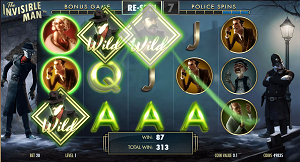 This NetEnt slot is based on the 1933 film, produced by Universal Studios. It features 2 shifting wild symbols. The Police wild appears on reel 1. It triggers wild re-spins and moves one position to the right until it works its way entirely across the reels. The Griffin wild on the other hand appears on reel 5 and moves horizontally to the left with each re-spin. These free re-spins create plenty of opportunities to win. If the 2 walking wilds collide, 10 free spins are activated. The wilds can appear anywhere on the reels during free spins and further collisions add an extra 4 free spins. Wild meters are filled as the wilds move off the reels, triggering either the bonus game or Police spins. In the Police spins feature, 5 flaming wilds are randomly placed on the reels for each of the 3 free spins. Whilst the bonus game is a multi-level pick and win feature.
 For many slots players, wilds are the key feature that set one slot apart from another. In their most basic form, a wild symbol will substitute for most other regular symbols. As such, they can turn a losing spin into a winner. They can even multiply your payout. In the age of online slot machines, wilds have been given a whole new lease of life.